“Test me for everything” is a reasonable thing to ask for. But herpes is the one place where the standard blood test tends to create more problems than it solves — and that’s not our opinion, it’s the guidelines.
If you’ve ever asked for a full STI panel and then noticed herpes wasn’t on it, you may have assumed something was skipped. It wasn’t. Herpes is deliberately left off standard screening, and when patients ask us to add it, we usually talk them out of it.
Here’s the reasoning, because “we don’t do that test” is an unsatisfying answer without one.
What the Guidelines Actually Say
The U.S. Preventive Services Task Force recommends against routine blood screening for genital herpes in adolescents and adults who don’t have symptoms — including during pregnancy. That’s a Grade D recommendation, which is the Task Force’s way of saying the harms outweigh the benefits.
The CDC is equally direct: “HSV-2 serologic screening among the general population is not recommended.”
Two independent bodies, same conclusion. This isn’t a cost-cutting decision or an insurance issue — it’s a judgment about whether the test helps you.
The Problem: About Half of Positive Results Are Wrong
This is the part that surprises people.
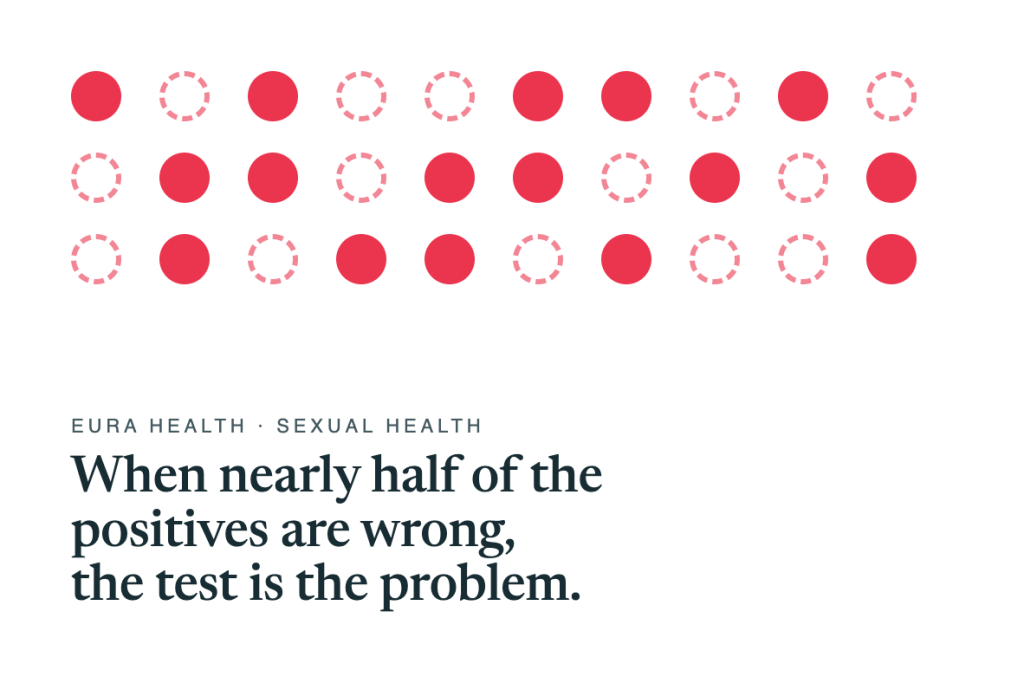
The most widely used herpes blood test correctly identifies almost everyone who has the virus — but it also flags a lot of people who don’t. The Task Force put it starkly: using the tests that are widely available, nearly one in every two positive results in the general population could be false.
To make that concrete: if you screened 10,000 people, you’d expect roughly 1,585 correct positive results — and about 1,445 incorrect ones.
There’s a technical reason behind it. These tests report a number, not just a yes or no, and results in the low range — an index value between 1.1 and 3.0 — are frequently false positives. A result of 1.4 gets reported to you as “positive.” It is often nothing.
A separate test you’ll sometimes see offered, herpes IgM, is worse still. It can’t tell the difference between herpes types, and it can turn positive during an old, long-standing infection while appearing to indicate a new one. CDC’s position is simply that it “is not recommended.” If a lab or a direct-to-consumer panel offers it, that tells you something about the panel.
Why a False Positive Is Worse Than It Sounds
With most lab tests, a false positive means a repeat test and a few anxious days. Herpes is different, because of what people do with the information.
A false positive can end relationships that didn’t need to end. It changes how people see themselves, sometimes permanently. It leads to disclosure conversations that were never necessary, and occasionally to daily medication for a virus someone doesn’t have. And it’s remarkably hard to un-know — even after a corrected result, the original one tends to linger.
That’s the harm the Task Force is weighing. Not the cost of the blood draw.
And a True Positive Often Changes Nothing
Here’s the other half, and it’s the part that usually settles the question for patients.
Suppose the test is right and you do carry HSV-2 without ever having had symptoms. What happens next?
There’s no cure, so there’s nothing to eliminate. And treatment isn’t indicated — CDC is explicit that for someone with a positive blood test but no symptomatic outbreaks, neither episodic nor daily suppressive therapy is recommended. The result doesn’t change your medications, your monitoring, or your health.
What it changes is how you feel. Herpes carries a stigma far out of proportion to what it actually does — for most people it’s an intermittent skin condition, and a great many people who have it never know. A test that delivers a heavy diagnosis while changing nothing clinically is a test worth thinking twice about.
What We Do Instead
None of this means we don’t take herpes seriously, or that testing never has a place. It means we test when the result will tell us something useful.
If you have symptoms, we test the symptoms. A sore, a blister, an unexplained irritation — that gets swabbed and run by PCR, which is the most sensitive way to detect the virus and tells us definitively what’s there and which type. This is a real answer, not a probability.
We do use blood testing in specific situations, and CDC supports each of them: when you have recurring or unusual symptoms but swabs keep coming back negative; when you’ve been told you have herpes but it was never confirmed by a lab; and when a partner has genital herpes and you want to know where you stand. In those cases the result actually informs something.
We treat symptoms properly when they’re there. Antiviral medication works — for shortening outbreaks, for reducing how often they happen, and for lowering transmission risk to a partner. That’s a conversation worth having, and it doesn’t require a screening test to start.
And we’ll talk about it without the weight. Plenty of what makes herpes hard is the stigma rather than the symptoms. If you’re carrying anxiety about this — whether you’ve been diagnosed, think you might have been exposed, or just want to understand your risk — that’s a conversation we’re glad to have.
The Short Version
Asking for complete STI testing is a good instinct, and for chlamydia, gonorrhea, syphilis, HIV, and hepatitis it’s exactly the right one. Herpes is the exception, and it’s an exception both the USPSTF and CDC make explicitly.
If you have symptoms, we’ll test them properly. If you have a specific reason to want blood testing, we’ll talk through whether it fits your situation. And if you just want to know that nothing is being skipped — nothing is.
Eura Health is a telehealth practice providing primary care, sexual health, and gender-affirming care across New York, New Jersey, Connecticut, and Colorado.
This article is general health information, not medical advice, and it doesn’t create a patient relationship. Testing decisions depend on your individual situation. Talk to a licensed clinician about yours.