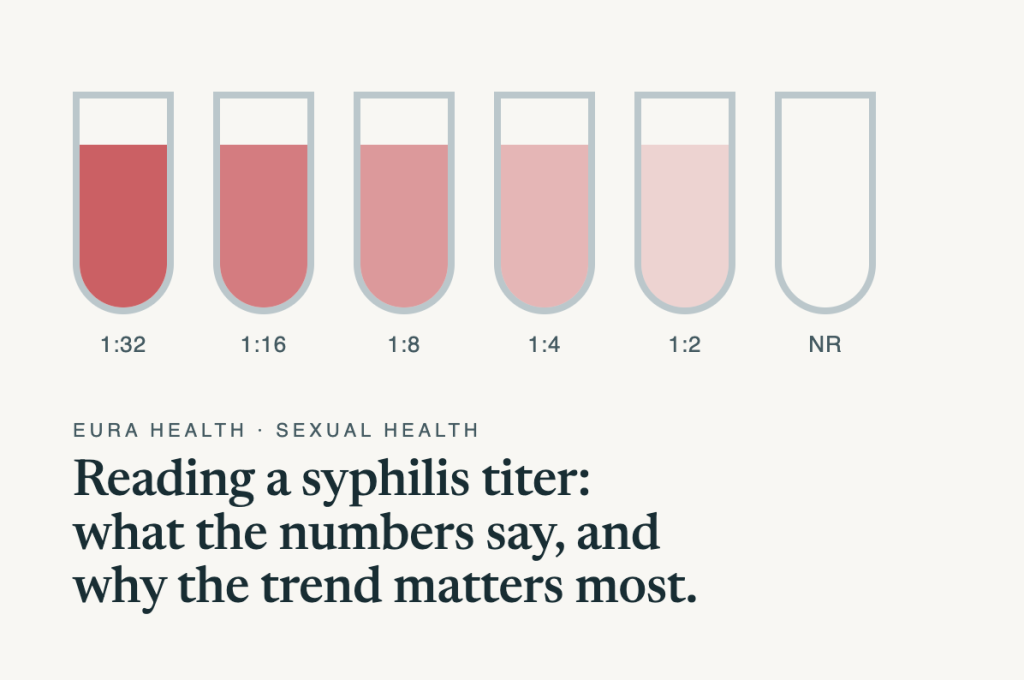
A syphilis titer is a measurement from a blood test that reflects how active a syphilis infection is in the body. It is expressed as a ratio — for example, 1:2, 1:8, or 1:32.
Titers are not just used to diagnose syphilis. They are a key tool for monitoring whether treatment worked and whether someone has been reinfected.
Understanding your titer result is an important part of syphilis care — and knowing what the numbers mean can help you have more informed conversations with your provider.
What Tests Measure Syphilis Titers?
Two commonly used tests measure syphilis titers:
RPR (Rapid Plasma regain): The most widely used titer test in clinical practice. Results are reported as a titer (a dilution ratio).
VDRL (Venereal Disease Research Laboratory): An older test that works similarly to RPR. Still used in some settings, including for cerebrovascular fluid testing when neurosyphilis is suspected.
Both are nontreponemal tests — meaning they detect antibodies the body produces in response to syphilis infection, not antibodies to the syphilis bacteria itself.
A separate class of tests — treponemal tests (such as FTA-ABS or TP-PA) — detect antibodies specific to Treponema pallid um, the bacterium that causes syphilis. Treponemal tests are used to confirm a syphilis diagnosis, but they typically remain positive for life and are not used to monitor treatment response.
How Do You Read a Syphilis Titer?
Titer results are reported as a ratio of antibody to fluid — for example, 1:8 means the sample still tested positive when diluted 8 times. A higher ratio means more antibody activity.
- Higher titer (e.g., 1:32 or 1:64) = more antibody activity, which typically indicates active or recent infection
- Lower titer (e.g., 1:2 or 1:4) = less antibody activity
- Nonreactive = no antibodies detected
What matters most is not any single titer result in isolation, but how it changes over time — especially after treatment.
What Happens to Titers After Syphilis Treatment?
After successful treatment, syphilis titers should decline.
The general expectation:
- A fourfold drop in titer (e.g., from 1:32 to 1:8, or from 1:16 to 1:4) within 6–12 months is considered a positive treatment response
- Some people achieve a nonreactive RPR after treatment
- Others maintain a low stable titer (often 1:1 or 1:2) even after successful treatment — this is sometimes called a serofast state and does not necessarily indicate treatment failure
Your provider will interpret your titer trend in the context of your symptoms, treatment history, and overall clinical picture.
What If Titers Are Rising?
A rising titer — particularly a fourfold or greater increase — after previous treatment can indicate:
- Reinfection: A new syphilis exposure after prior successful treatment
- Treatment failure: Less common with recommended antibiotic regimens, but possible
A rising titer should be evaluated promptly. Your provider will assess whether re treatment is needed and discuss risk-reduction strategies.
People at higher risk of syphilis — including those with multiple partners, people living with HIV, and men who have sex with men — benefit from regular syphilis screening so that reinfection is caught and treated early.
How Often Are Syphilis Titers Monitored?
After syphilis treatment, follow-up titer testing is standard. Common schedules include:
- 6 and 12 months after treatment for early syphilis (primary, secondary, or early latent)
- 6, 12, and 24 months after treatment for late latent syphilis or syphilis of unknown duration
- More frequent monitoring for people living with HIV — typically at 3, 6, 9, 12, and 24 months
Your provider will recommend a schedule based on the stage of syphilis treated and your individual health history.
Syphilis and HIV: Why Monitoring Matters More
People living with HIV who contract syphilis require closer monitoring.
HIV can affect how the immune system responds to syphilis, potentially altering the titer response and increasing the risk of neurological involvement (neurosyphilis). Treatment recommendations and follow-up schedules may also differ.
If you are living with HIV, syphilis should be screened for regularly and managed in coordination with your HIV care provider. Eura Health provides integrated HIV care and sexual health services.
Frequently Asked Questions About Syphilis Titers
What is a normal syphilis titer?
A nonreactive (negative) result means no syphilis antibodies were detected. There is no single “normal” titer for someone with a history of syphilis — what matters is the trend over time and whether titers are declining after treatment.
Can titers stay positive forever?
Treponemal tests (like FTA-ABS) typically remain positive for life after syphilis infection regardless of treatment. Nontreponemal tests (RPR, VDRL) should decline after treatment, though some people remain at a low stable titer — this is known as serofast.
What does a 1:32 titer mean?
A 1:32 titer means the sample was still reactive when diluted 32 times — indicating significant antibody activity. This level is consistent with active or recent syphilis infection and should be evaluated and treated.
What is a fourfold change?
A fourfold change is a doubling or halving of the dilution ratio twice. For example: 1:8 → 1:32 is a fourfold increase (possible reinfection or treatment failure). 1:32 → 1:8 is a fourfold decrease (expected treatment response).
How do I know if my syphilis treatment worked?
A fourfold drop in titer within 6–12 months is the standard indicator of treatment response. Your provider will schedule follow-up labs to confirm.
Should I be tested for syphilis regularly?
People with multiple partners, men who have sex with men, and people living with HIV are generally recommended to screen for syphilis regularly — at least annually, and more frequently depending on risk factors.
Get Tested and Treated
Syphilis is common, treatable, and — with proper monitoring — fully manageable.
At Eura Health, STI testing, syphilis treatment, and titer monitoring are part of routine sexual health care. You do not need a separate referral or specialist — your provider can manage this as part of your ongoing care.
Request an appointment with Eura Health.
Medical Disclaimer: This article is for general educational purposes and is not a substitute for individualized medical advice, diagnosis, or treatment. Syphilis diagnosis and management require clinical evaluation. Discuss your results and treatment with a qualified healthcare professional.